

Heating costs are likely to be quite high this winter, especially for anyone heating with oil, or propane, electric baseboards, or electric space heaters. Installing a heat pump would certainly reduce their annual heating costs and emissions, and it would probably improve their comfort year round.
For anyone currently dependent on natural gas, a heat pump is likely to yield smaller savings today; but those savings are likely to grow over time. Heat pumps do offer other advantages over gas heat, including: lower emissions, summer-time air conditioning, and quieter, more precise comfort control. Widespread adoption of heat pumps can cause the fixed costs of transmission and distribution systems to be spread over more kilowatt hours, thus putting downward pressure on electric rates.
What are Heat Pumps?
You are already familiar with simple heat pumps. Your refrigerator pumps thermal energy from inside the refrigerator to outside it. A window air conditioner works in the same way, moving thermal energy from inside to outside.
Now, imagine a more sophisticated heat pump, able to move heat in two directions. In winter it captures heat outside the house and pumps it inside. In summer, it does the opposite. And, because of its more sophisticated design, it can cool a home more efficiently than an older AC system.
There is a remarkable efficiency difference between a heat pump and furnace or boiler. When a fuel is burned, converting chemical energy to heat (thermal energy), some of that energy inevitably goes up the stack. Although modern gas heating systems can achieve 98% efficiency under optimal conditions, older furnaces and boilers, particularly units burning oil or propane, can have efficiencies as low as 70%. So, when you buy and burn $1 worth of fuel in a furnace or boiler you will get somewhere between $0.70 and $0.98 worth of heat for the house. And there are other, indirect, economic inefficiencies. Emissions from burning a fuel in your home affect both the local and global environment. Sooner or later, people inside and outside of it are likely to suffer the health and/or economic consequences of that pollution. To the extent heat pumps are powered by nuclear energy or renewable energy, that pollution is vastly reduced; and even if the electricity for a heat pump is generated by burning gas, the pollution is less than if that gas was burned in a furnace.
Since heat pumps move thermal energy instead of creating it, they can turn each unit of electrical energy input into more than one unit of useful thermal energy output. The ratio of energy input to energy output is referred to as the heat pump’s coefficient of performance (COP) and for modern heat pumps the COP is typically between 1.5 and 6.0 (i.e. 150% to 600%), depending primarily on the temperature difference between the hot and cold ends of the heat pump.
Types of Heat Pumps
Air-Source Heat Pumps (ASHP) transfer heat between indoor air and outdoor air. ASHPs installed before 2010 often stopped working well when the outdoor temperature dropped below freezing (32 °F) and the installer would set things up so that a furnace or boiler would take over at that point. Today it is still true that the bigger the difference between indoor and outdoor temperatures, the harder a heat pump needs to pump and the lower the COP. But modern cold-climate air-source heat pumps (ccASHP) typically deliver a COP greater than 3.0 when the outdoor air temperature is above freezing, and the COP might drop to 1.5 when the outdoor temperature is -10 °F.
A properly selected and installed ccASHP can reliably keep a Rhode Island home comfortable in winter. It can do so at lower cost than a furnace or boiler burning oil or propane, and at much lower cost than electric space heaters or electric resistance heating systems. At today’s energy prices, homes currently heating with natural gas could also save money by using a heat pump when the outdoor temperature is above 30-45 °F (depending on the type of heat pump and furnace involved).
Ground-Source Heat Pumps (GSHP) work by running a closed loop of anti-freeze liquid underground, transferring heat from the ground into your home during the colder months, and pumping heat out of the home and into the ground during the hotter months. Because the temperature underground is typically around 50-55 °F year round, GSHP are more efficient than ASHP, typically offering a COP of 3.5 to 4.5 Thus, GSHP have lower operating costs and demand less from the electric grid. On the other hand, GSHP have significantly higher up-front costs because drilling is so expensive. That might change in the future as the technology improves, as local capacity for geothermal drilling increases, and as the market moves from doing one home at a time to hooking entire neighborhoods into an underground thermal energy network (TEN). Such networks typically include many boreholes, an underground water loop connecting the boreholes to the buildings, and the buildings with each other. The temperature of that water loop is typically around 55 °F, and heat pumps extract heat that water, or reject heat to that water, depending on the needs of each building. Thermal energy networks can be particularly efficient when the buildings have diverse energy needs; for example, picture a network that includes an ice rink or a data center that is always injecting heat into the water loop, and a commercial laundry or a factory is always extracting heat from that loop.
Hybrid Heating Systems
A hybrid heating system is one that uses a heat pump AND a conventional furnace or boiler. To minimize annual heating costs, homes dependent on oil or propane would typically use a heat pump for almost the entire heating season and would only burn fuel on the coldest days and nights. Homeowners heating with natural gas would typically transition from ASHP to furnace or boiler when the outdoor temperature drops near or below freezing and it becomes more expensive to run the heat pump than to run the furnace; but if the homeowner’s wishes to minimize their emissions then they could choose to continue relying on an ASHP down to its design temperature (typically around 10 °F in Rhode Island).
For most New Englanders, a hybrid system offers the best of both worlds: lower winter heating costs, better summer comfort, and better reliability. Heat pumps — like furnaces and boilers — can sometimes fail to run when we want them to run. So, when retrofitting a heat pump to an existing home, home owners are often well advised to keep their old heating system in good working condition as a backup. Conversely, if a heat pump is installed before the old heating system dies, the lifetime of the old furnace or boiler can be extended.
Keeping old heating systems in place can also be a form of good citizenship. Ten years from now, when heat pumps are likely to cause peak electricity demand to occur in winter rather than summer, and when renewables are likely to provide more of our electricity supply, homeowners with hybrid systems can help to keep everyone’s lights on and to keep everyone’s electricity costs down by pitching in when the the local electric utility or regional grid operator sends out a signal that they need help balancing electricity supply and demand. On those rare occasions when electricity is in short supply and wholesale electricity prices spike, it would be very helpful if thousands of homes were to switch temporarily from heat pumps to those old furnaces and boilers.
How much might you save if you had a heat pump?
How much a heat pump might save you will depend on the relative price of electricity versus the fuel used in your current heating system. And while it is hard to predict what those prices will be in the future, we can look to the past to get a sense for how things might change from year to year.
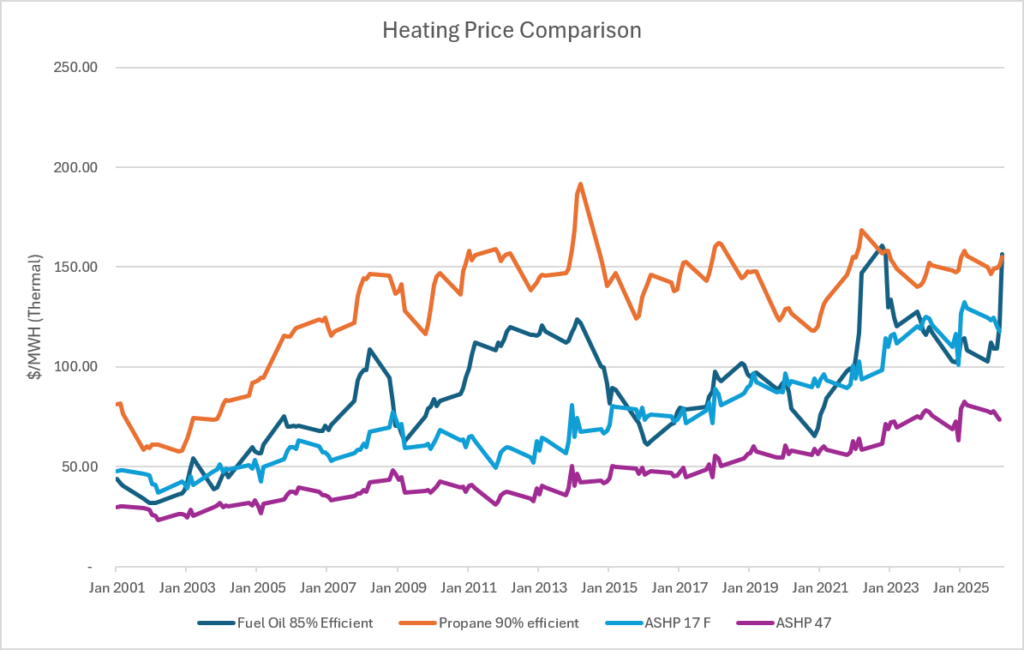
The chart below combines historic price data from the US Energy Information Administration with the typical efficiencies of different heating systems to show the variable cost per unit of useful thermal energy delivered to a home. Over the past 25 years, propane (the orange line) has been the most expensive way to heat a home in Rhode Island. Fuel oil (the blue line) has typically been around 35% less expensive. If modern heat pumps had been available over that entire period, an ASHP would have cost less to run than an oil furnace — around 50-75% less when the outdoor temperature was 47 °F and 5-50% less when the outdoor temperature was 17 °F.
As shown in the chart below, a heat pump has been cost competitive with a gas furnace since 2014 at 47 °F or above. Up until 2012, a ccASHP would have been cost competitive down to around 17 °F. Today, if your goal is to minimize annual heating costs and you have both gas and a heat pump available, you might want to use gas when below freezing and your heat pump when above freezing. That economically optimum switching temperature is likely to go lower over the next 10-20 years. If you heat with gas today and would like to reduce your home’s carbon footprint, installing a heat pump would be a good way to shrink that footprint.
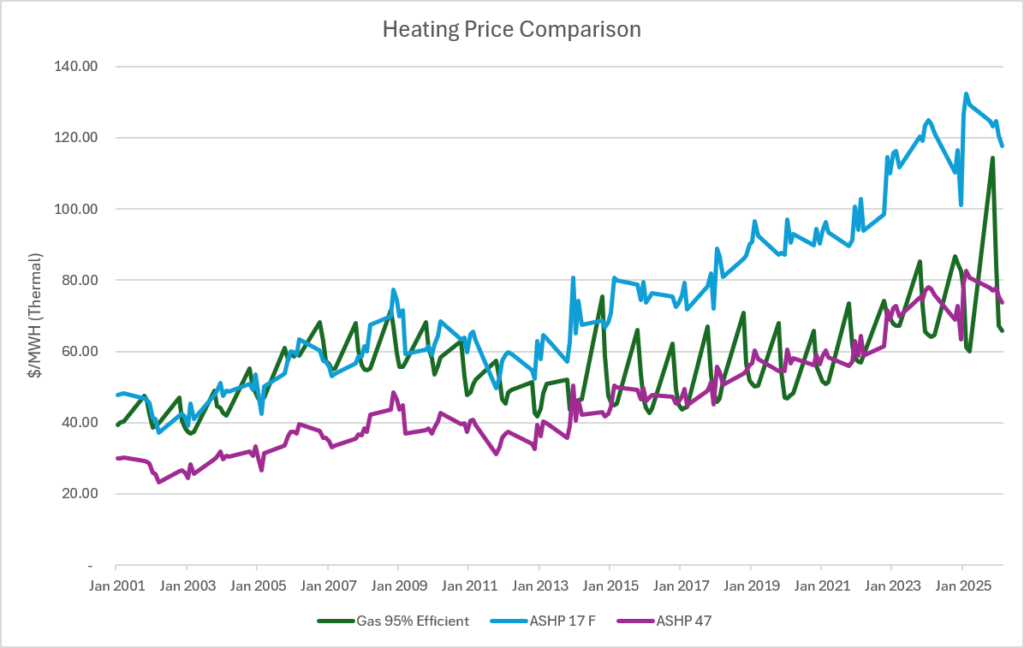
There are a few reasons to think that heat pumps will look even better than suggested by the charts above. First, it seems likely the electricity delivery charge will soon be reduced for heat pump users; in fact, a discounted “seasonal heat pump rate” is already available to residential customers in Massachusetts. Second, ASHP technology continues to improve. And third, while ASHP are the dominant choice today, higher efficiency GSHP are likely to gain market share in the future, offering residents a higher COP and lower operating costs..
Don’t forget the water heater
In Rhode Island, most of us spend a lot more to keep the house warm in winter than to make hot water year round. Nevertheless, the cost of making hot water the old fashioned way is high enough that you really should consider the benefits of a heat pump water heater (HPWH). These appliances are about the same size as a conventional electric water heater but use 3-4x less electricity. A HPWH can make all of the hot water needed by a family of four while using less energy than it would take to run a 150 W incandescent light bulb. And in summer, a HPWH installed in a basement will reduce the need to run a dehumidifier. If you have already installed a heat pump for space heating but haven’t yet done the same for water heating, you should definitely look into getting a HPWH.
If you are still using an old-fashioned electric water heater, the payback on a heat pump water heater can be particularly quick. And if you are heat-pump-curious but aren’t ready to buy enough heat pump capacity to heat the entire house, a HPWH is a nice way to begin your electrification journey. At least look into it before your existing water heater dies so, when you are forced to replace your existing water heater, you will already know what you want and how to get it installed.
Why you should encourage your neighbor to install a heat pump
Broad adoption of heat pumps could reduce your electric bill even if you do not install a heat pump yourself. To understand why, you need to know a little about residential electric rates and how they are set.
A typical residential electric bill can be thought of as a combination of three charges: fixed, supply, and delivery. The fixed charge is small, typically only a few percent of the total bill. The delivery charge ($) usually accounts for more than half of the bill, and that charge is calculated by multiplying the delivery rate ($/kWh) and the amount of electricity delivered (kWh).
The delivery rate is calculated by the local utility company and approved by the Public Utilities Commission (PUC) based on (a) the total money owed to the utility for ownership, maintenance, and operation of the poles and wires and other equipment that delivers electricity from where it is produced to where it is used, and (b) the total amount of electricity delivered.
The utility’s cost of ownership, maintenance, and operation is the result of what equipment has been deployed. And that equipment has been selected and deployed based on forecasts of the peak demand (kW) that the utility will need to handle. Peak demand only occurs for a few hours each year, typically during the hottest, most humid summer afternoons. The rest of the year, the amount of electricity being delivered to customers is much lower than the system is capable of delivering, typically averaging around 50% of design capacity on an annual basis. In winter months, the existing equipment could probably deliver roughly 80% more electricity than we use in an average winter month.
Recognizing that the delivery rate calculation by the utility company looks like this:
Delivery rate ($/kWh) = Annual system cost ($) / Annual kWh
it is clear that the delivery rate could be reduced if the total amount of electricity being delivered increases faster than the annual system cost.
In other words, the delivery rate can be reduced if (a) peak demand is kept nearly constant, thus minimizing the need for new investments in the delivery system and holding annual system cost nearly constant, and (b) more kWh are delivered at times when there is spare delivery capacity.
Deploying more heat pumps would be a really beneficial way to increase electricity consumption at times where there is spare capacity available. Modern heat pumps are easily programmed to minimize energy use during periods of peak demand. And hybrid heating systems make it possible to defer utility investments that would be needed merely to increase peak delivery capacity.
To summarize: more heat pumps = lower electricity delivery rates.
Heat pump adoption might also affect the price of electricity supply during the heating season in a favorable way. Here’s why:
- Because of the difference in energy efficiency, every home switched from electric resistance heating to heat pumps liberates enough electricity supply to power heat pumps in two other homes of similar size.
- Every two homes switched from gas heat to heat pumps liberate enough electricity to power the heat pump in a third home of equal size (and perhaps more if those switched from gas to heat pump use GSHP rather than ASHP.
- For every home currently heated with oil or propane there are, currently, at least two homes heated with gas.
So, in the long run, heating electrification, the growth of renewables, and the successful deployment of a new generation of clean, base load, power plants are all likely to reduce the need for gas to generate electricity. These changes have often been promoted as ways to reduce greenhouse gas emissions; and some people have argued against them for that reason. But, in fact, these changes are likely to reduce the strain on the gas supply in winter and can therefore help to reduce the wholesale price of electricity supply in the ISO-NE region.
Where to go for more information on heat pumps
If you live in Rhode Island, you might qualify for state incentives or assistance to install a heat pump. To find out if you do, go to Clean Heat RI, a program run by the state Office of Energy Resources that can also help you find installers.
Alternatively, for help finding qualified installers or comparing quotes, visit the EnergySage website.
No matter where you live in America, whether you own or rent your home, if you are thinking of getting off fossil fuels and electrifying where you live and how you get around, a good place to start is the personal electrification planner offered by Rewiring America. Or, if you live in Massachusetts or Rhode Island and want to learn more about reducing your costs and emissions, get in touch with the good folks at Green Energy Consumers Alliance.
And be sure to sign up for our newsletter. Over the next few months we will be writing more about the connection between electrification, electricity rates, and how we can make the electric grid cheaper and more reliable.