

We waste a lot of energy, not because we are careless (although sometimes we are), but because of the way our world is built.
Scientists have traced how energy is produced, delivered, and used across industry, electricity generation, transport, other businesses, and homes. Their findings, for the USA, are summarized below.
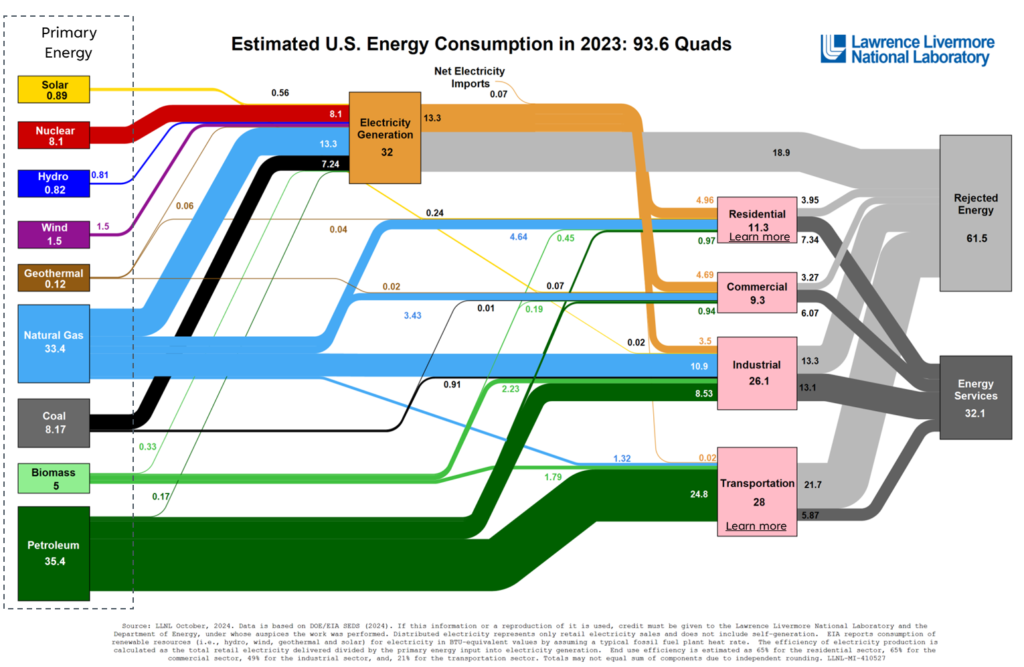
All of the energy we extract from the ground, or capture from dams, wind turbines, and solar panels is shown on the left side of that diagram. In 2024 that “primary energy” totaled around 94 quadrillion BTU or “quads”.
Very few people love coal or gasoline or electricity, as such. We love the services those primary energy sources provide — services like hot showers, cold beer, the ability to step on the gas and quickly get across town, the cultivation and preparation of our food, etc. The total, useful, energy services — the extra thermal energy contained in that hot water, the motion of the moving car, etc. — is represented by the box in the lower right corner of the diagram.
Notice that around 2/3 of the primary energy sold in America ends up as “rejected energy” or “waste heat”.
From a global perspective, the waste is even worse. By burning so much coal, oil, gas, etc. over the past 200 years, humans have altered the composition of the atmosphere and caused a planetary energy imbalance. Earth now absorbs more energy from the sun than it radiates back into space, thus heating up the planet (mostly the oceans). That radiation imbalance is much bigger than global primary energy consumption. For every unit of primary energy we Americans consume, another 20 units of thermal energy from the sun is going into the ocean, raising ocean temperatures, and driving American lobsters farther north (among other ill effects).
We can do a lot better. In doing so, we can save money and cut pollution. Learn how electric heat pumps can improve the energy efficiency of buildings and thereby save money. In future newsletters we will point to lots of other energy-saving and money-saving ideas.